Wednesday, October 5, 2011

Day 44: Raptors and phrastic

Somebody sneezed and then it was autumn. Nowhere was this more apparent than the marsh, whose long summer of sweltering heat and mosquitoes surrendered overnight to cool breezes and migrating raptors. I was very hopeful that the maiden deployment of camera trap #2 would yield a bird of prey. And it did. One photo of an unidentified juvenile accipiter (lower right corner).


This portrait left much to be desired. Fortunately, the raptors made up for it with a live show that lasted all day. Adults and juveniles darted in and out of the treeline by the dozen, inciting the marsh's refugee songbirds to repeatedly dive for cover. Rocky Point is a smorgasbord for bird-eating birds, and death from above took many forms: accipiters, merlins, peregrines, oh my!


They shared the sky with another voracious aerial predator (of fuel): the Airbus A380-800, AKA the world's largest passenger plane. This is the Lufthansa subspecies, buzzing the marsh on it's daily migration from JFK to Frankfurt. It may not look like much, but 526 people are crammed into that thing.


Moshe, Urzula and Kim-Nora plus me made four in the marsh today.


We consolidated our efforts to clear the mouth of Matchstick Alley. With most of the big wood gone, we turned our attention to the ubiquitous phrastic, my term for the moist, concentrated mixture of dead phragmites and plastic debris that sometimes results from the action of tides and delinquent New Yorkers.


Not long ago it covered much of the marsh, smothering the native flora and choking the channels. It now clings to a precarious existence in only a few remaining nooks.

Moshe went in deep to eradicate the stuff.


While Kim-Nora and Urzula raked and scooped.


And hauled it off to the pile.


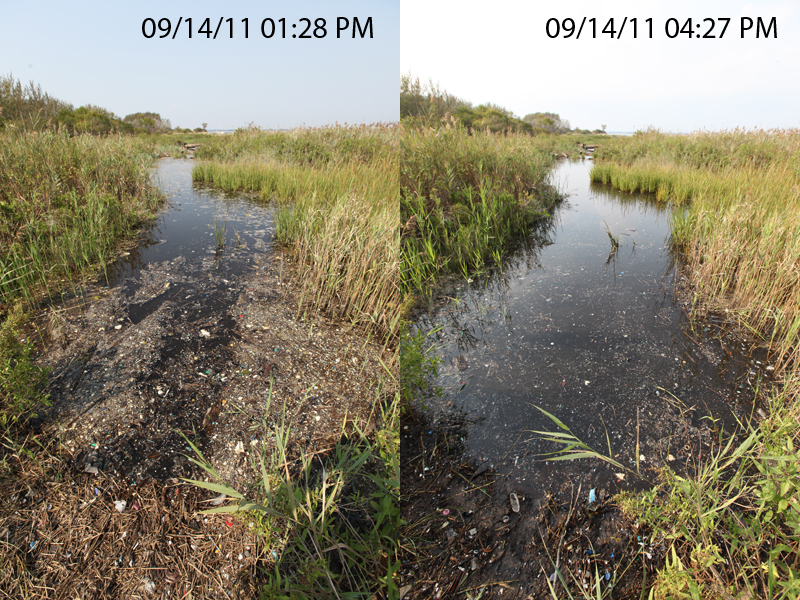
This before-after would have been much more dramatic had I not been shooting into the sun, but there it is.


And one more, depicting one of the smaller alcoves in Matchstick Alley.


Thank you Kim-Nora, Urzula and Moshe for your marsh husbandry and compassion. Rocky Point is very lucky to have friends like you.

High of 74, max humidity 72%, average wind (NNW) @ 15 MPH, 5.3 high tide @ 03:24 PM. Moon 58% visible.
Water level unrecorded
Birds seen in marsh: osprey, merlin, peregrine, unidentified accipiters, Canadian goose, flicker, warbler, kingbird, mockingbird, black-backed gull

Wednesday, September 28, 2011

Day 43: Tide race and fall migration

At seven feet, today's tide was the biggest the marsh had seen all year. I'd been waiting for this one. The unprecedentedly high water would do all the heavy lifting while I leisurely floated logs to the culvert for later removal. But once in the marsh I realized I only had an hour before the logs started scraping bottom. And the logs were many. Here's my race against the tide, partially filmed in Beavervision©.


And the resulting logjam-boree.


The deluge was intense. To illustrate, here's the main pool today vs. during a dry spell.


Throughout the day I kept crossing paths with Jim Henson's lost creation.


Here less muppet-like. A great egret's dagger bill is lethal when it comes to sniping unsuspecting fish and non-fish. 


It stalks silently through the marsh, searching for any movement in the water. When a potential meal is detected, the egret zeroes in, cocks it's neck and like lightning...


This individual was a pro. Not a single fumble in the dozen strikes I witnessed. 


It was an especially birdy day all around thanks to the fall migration. Geese, cormorants, four raptor species and an endless procession of tree swallows coasted over Rocky Point. It took one flock of swallows two hours to pass overhead. During our last volunteer day, USFW biologist Steve Finn told me about the non-avian migrants he observed in the marsh:

The butterflies are the most interesting to me at this time of year with their different survival strategies. Some migrate south in advance of the cold weather. Most notable are our monarch butterflies that migrate to the Oyamel forests in Mexico, where they will spend the winter. Lesser migrations to our southern states are performed by some of our other butterflies such as the question mark, ladies and morning cloak, although some of the morning cloaks don't migrate and stay to hibernate in a sheltered place such as a hollow tree. 

During our marsh clean up on Saturday we disturbed such a sleeper when Tony and I unloaded a pile of wood taken from the marsh waste (left). Finally (and perhaps sadly) we witnessed butterflies in the marsh area such as the beautiful common buckeye (right) that immigrated northward during the summer to explore new habitat, food sources and reproduce. These will stay with us into autumn until they are finally killed by the frost. The only good news is that they will be replaced next year with fresh southern immigrants. 

butterfly photos courtesy Steve Finn
Following the marsh work I went fishing with Tony down the beach from the marsh. Here again we witnessed migration. The bait fish (peanut bunker or young of the year menhaden) were heading towards the inlet to migrate south from their nursery grounds in the bay. They were being heavily fed upon by migrating snapper bluefish, striped bass and false albacore trying to fatten up before their long trip south. 

In hopes that a few migrating birds will stopover in the marsh, I decided to deploy camera trap #2 on the osprey platform. But the cradle, whose not-very-hurricane-proof design resulted in the demise of camera trap #1, required modification.


It's not overly sophisticated, but this little brace will help secure the camera during a big gust.


The glorious view from the roof of the marsh. What weary traveller wouldn't want to take a rest here?


I finished off the day in Matchstick Alley. It's slow going, but the channel is beginning to open.


High of 75, max humidity 90%, average wind (ESE) @ 11 MPH, 7.0 high tide @ 08:49 AM. Moon 0% visible.
Water level recorded at 30" mark (marsh record high). Yardstick broke shortly thereafter.
Birds seen in marsh: belted kingfisher, green heron, great egret, osprey, merlin, peregrine, unidentified accipiter, black duck, Canadian goose, flicker, warbler, tree swallows, grackle, many large gulls.

Friday, September 23, 2011

Day 42: Search and destroy

The combination of zero wind, 100% humidity and droning rain activated Rocky Point's resident mosquitos into full attack mode. They had the egret shaking like a golden retriever.


But we never abort an operation due to hostile conditions. The only exposed part of my body was my face, which I generously slathered with bug dope. Moshe, however, went full-on commando.


There was a lot of post-cleanup cleanup to do in the main channel.


Rambo's Moshe's strategy was to melt into the undergrowth, silently creep up on the logs and take them out one by one. He was nearly thwarted when a mosquito slipped under his face net. Evasive counter-insurgency maneuvers kept him in the game.


We then turned our attention to the remaining logs in Matchstick Alley. The aim was to remove them before the big flush next week, when a rare seven-foot tide will bore through the recently cleared channel. Those two monsters on the right will have to wait for the next chainsaw session.


Targets eliminated. But wait, where's Moshe? Moshe?


High of 71, max humidity 100%, average wind () @ 5 MPH, 5.6 high tide @ 04:46 PM. Moon 26% visible.
Water level recorded at 5" mark.
Birds seen in marsh: belted kingfisher, green heron, great egret

Saturday, September 17, 2011

Day 41: Marsh militia breaches new channel

Rocky Point's fourth group cleanup day didn't break any turnout records, but made the greatest impact yet in terms of actual marsh restoration. This was because the 14 resolute individuals who showed up were both highly motivated and experienced in marsh making. Our mission was clear: open the clogged channels. 

But the first order of business was removing the small wood piles. Gateway National Recreation Area wanted wood for their summer camp programs, and we were happy to oblige. After sorting out the treated stuff we sent the burnable pieces by wheelbarrow to the pickup. Clockwise from upper left: Lisa, Cindy, Broc and Rob on firewood detail.


Tony and Steve then taxied the loads to the Floyd Bennet field campgrounds. Here's Tony betwixt twins Broc and Steve.


Hurricane Irene created a monstrosity of a logjam in the west channel. Some of these logs were the size of telephone poles, and would require significant butchering prior to removal. Alecio was the first to man the chainsaw at no small risk to himself. Most of the marsh lumber contained more metal spikes than an E.L.F. member's backpack.


Meanwhile, Alex, who set the hardcore bar pretty high during his last visit, outdid himself by cutting down logs with a handsaw.


Broc reported for carving duty by early afternoon, after a full morning of loading firewood.


He focused on a yet-untouched artery of the west channel. Here are the offending logs, slumbering peacefully...


...right before the wholesale slaughter ensued.


As the sawmen hacked away the rest of us shuttled dismembered log chunks out of the marsh. Unfortunately, wheelbarrows weren't an option.


So we did it Viking-style. Here are Moshe, Sarah and Josh making it look easy.


In case you're not convinced we worked hard enough, here are a few more.


!
!!
!!!

!!!!

Don and Francois stopped by to check out the action.


Even the boy made an appearance. This was the first time in his whole three week-long life he'd ventured outside of Manhattan.


Auntie Aida and Grandma Violeta drove all the way from White Plains and the Bronx to deliver him and the wife.


After six hours we'd made quite a pile, here with Santos and Cindy for scale.


And here's introducing Rocky Point's newest addition, the northwest channel. Maybe we should call it Matchstick Alley. Now open for business.


Thanks to Steve, Alecio, Lisa, Cindy, Broc, Rob, Josh, Alex, Sarah, Moshe, Francois, Jonathan for working so hard on your day off. Thanks to grandma Violeta, auntie Aida, Irene, Francois and Don for stopping by. And as always, thanks to Tony for everything.

Photos by Irene

High of 66, max humidity 72%, average wind ENE @ 8 MPH, 5.2 high tide @ 11:18 AM. Moon 82% visible.
Water level unrecorded.
Birds seen in marsh: belted kingfisher, green heron, osprey, great egret, unidentified accipiter, eastern kingbird, yellow fronted warbler, robin

Wednesday, September 14, 2011

Day 40: Crop circles and killi-clemency

Upon arrival I found the marsh plagued by unexplained phenomena. What you see below was one of several circular formations, each stretching about thirty feet in diameter. There could only be one rational explanation.


Then I recalled reading about these circles. During late summer, large patches of salt hay (spartina patens) lay down in matted, swirling patterns aptly named cowlicks. The dying grass, usually out of the tides' reach, stays in place and does not effect the succeeding generation's growth. In fact, it stabilizes the substrate.


I started the day trying to operate the seine by myself. This ranks high among those two-person tasks whose doubtless failure as a solo endeavor only goads one into attempting success. Fortunately, Moshe was available. When operated correctly seine nets are very effective at skimming the nano debris, especially particulate plastic, from the marsh surface.


The problem is they're also very effective at skimming the organisms that swim in the marsh. After unraveling the net we found the debris jerking with dozens of frantic killifish. Some might say you can't make an omelet without breaking a few eggs. And killifish are legion, yes. But they're also the most voracious predators of my sworn enemy, the salt marsh mosquito. How many blood-sucking insects would live for each killifish that perished? I didn't want to find out, and so began the exacting work of picking the killis, one by one, from the net. 


And liberating them.


Those that could not be saved, I reassured myself, would make good treats for whatever lurks around the debris piles.

We attempted to scare fish away during subsequent skims by walking in front of the net. This tactic significantly reduced bycatch, and would work much better with a third person, a dedicated fish herder, leading the net draggers. In the end, the seine was worth the sacrifice.


and


I finished the day in the shop preparing for Saturday's cleanup event. Hope to see you there.

References:

The Effect of a Seasonal Change in Canopy Structure on the Photosynthetic Efficiency of a Salt Marsh.
S. N. Turitzin and B. G. Drake. Oecologia. Vol. 48, No. 1 (1981), pp. 79-84

The Behavior of Fundulus heteroclitus on the Salt Marshes of New Jersey. F. E. Chidester. The American Naturalist.
Vol. 54, No. 635 (Nov. - Dec., 1920), pp. 551-557

High of 82, max humidity 90%, average wind SSW @ 10 MPH, 5.7 high tide @ 9:36 AM. Moon 98% visible.
Water level recorded at 10 inch mark.
Birds seen in marsh: belted kingfisher, green heron, osprey, great egret
Birds seen in bay: great egret