Wednesday, September 14, 2011

Day 40: Crop circles and killi-clemency

Upon arrival I found the marsh plagued by unexplained phenomena. What you see below was one of several circular formations, each stretching about thirty feet in diameter. There could only be one rational explanation.


Then I recalled reading about these circles. During late summer, large patches of salt hay (spartina patens) lay down in matted, swirling patterns aptly named cowlicks. The dying grass, usually out of the tides' reach, stays in place and does not effect the succeeding generation's growth. In fact, it stabilizes the substrate.


I started the day trying to operate the seine by myself. This ranks high among those two-person tasks whose doubtless failure as a solo endeavor only goads one into attempting success. Fortunately, Moshe was available. When operated correctly seine nets are very effective at skimming the nano debris, especially particulate plastic, from the marsh surface.


The problem is they're also very effective at skimming the organisms that swim in the marsh. After unraveling the net we found the debris jerking with dozens of frantic killifish. Some might say you can't make an omelet without breaking a few eggs. And killifish are legion, yes. But they're also the most voracious predators of my sworn enemy, the salt marsh mosquito. How many blood-sucking insects would live for each killifish that perished? I didn't want to find out, and so began the exacting work of picking the killis, one by one, from the net. 


And liberating them.


Those that could not be saved, I reassured myself, would make good treats for whatever lurks around the debris piles.

We attempted to scare fish away during subsequent skims by walking in front of the net. This tactic significantly reduced bycatch, and would work much better with a third person, a dedicated fish herder, leading the net draggers. In the end, the seine was worth the sacrifice.


and

I finished the day in the shop preparing for Saturday's cleanup event. Hope to see you there.

References:

The Effect of a Seasonal Change in Canopy Structure on the Photosynthetic Efficiency of a Salt Marsh.
S. N. Turitzin and B. G. Drake. Oecologia. Vol. 48, No. 1 (1981), pp. 79-84

The Behavior of Fundulus heteroclitus on the Salt Marshes of New Jersey. F. E. Chidester. The American Naturalist.
Vol. 54, No. 635 (Nov. - Dec., 1920), pp. 551-557

High of 82, max humidity 90%, average wind SSW @ 10 MPH, 5.7 high tide @ 9:36 AM. Moon 98% visible.
Water level recorded at 10 inch mark.
Birds seen in marsh: belted kingfisher, green heron, osprey, great egret
Birds seen in bay: great egret

Wednesday, September 7, 2011

Day 39: Lumber wars begin

It was one of those schizophrenic weather days at Rocky Point where the sun made brief appearances between light mist, punctuated by the occasional two-minute deluge. A peregrine swooped in and seemed obsessed with something in the middle marsh where the willets once nested. She made a dozen frenzied dives at the same spot but nothing moved there, even minutes after she'd flown away.


The brutal task of removing the logjams commenced today with the assistance of Moshe, who selflessly forfeited a few hours of fishing to haul heavy wood. Treated lumber impregnated with various chemicals littered the west channel. Many were waterlogged and would have been invisible were it not for the curious leachings suspended above their wooden corpses.

"It feels wrong to say it, but it's sort of beautiful," Moshe confided while standing over an especially hallucinatory swirl in the west channel. Indeed, it was kind of cool, in a revolting way.


Many of the logs were the size and weight of small cars and would not yield to our two-man team. So we focused on wood that was just big enough to not cause back injuries.


By the time we'd moved about a dozen timbers the rain compelled us to call it quits, and I returned to the shop to finish my first recycled marsh wood bat box. All pieces are cut and by next week it should be ready for tenants.


High of 68, max humidity 100%, average wind ENE @ 11 MPH, 5.6 high tide @ 4:48 PM. Moon 72% visible.
Water level recorded at 10 inch mark.
Birds seen in marsh: belted kingfisher, unidentified peep, mockingbird, green heron, osprey, peregrine falcon, spotted sandpiper
Birds seen in bay: Canada goose, semipalmated plover

Monday, September 5, 2011

Underwater timelapse test

Before undertaking my post-hurricane survey I took advantage of the 6.5' high tide to shoot a new variation on the falling tide timelapse. The idea manifested last week in the recycling room of our apartment building, where I discovered sitting beside the cardboard bin a perfectly sound terrarium containing nothing but a few dead crickets.

The tide was one of the largest all summer, flooding the marsh with the usual suspects plus a few new visitors. Small schools of baby bluefish, or snappers as they're locally known, patrolled the channels for silversides and killifish. At eight inches or so, they're the largest fish I've encountered in the marsh. A belted kingfisher also made several flybys but never took a dive.

Here's the setup (photo taken at the end of the shot).


And the timelapse, documenting one hour of peak drainage reduced to 15 seconds.


Thursday, September 1, 2011

Day 38: What Irene hath wrought

I took a two week hiatus from marsh work because my wife Irene spawned a Category 3 storm of our own:


We brought him home a few hours before the other Irene hit NYC. That night we huddled in the apartment watching movies beside our emergency pile of water-filled wine bottles, canned goods and headlamps. Although our East Village apartment sits on the cusp of the B and C hurricane evacuation zones, I had a feeling we'd be fine. But Rocky Point would inevitably be transformed. The storm surge combined with a freakishly high tide could either flood the marsh with new junk or suck the old junk out to sea.

Today I went to see what Irene did to the marsh. Here are a few scenes from my survey.


The most conspicuous effect was this logjam in the west channel. These timbers were already in the marsh, but the storm rearranged them into an effective dam. Water still flows below.


The western reaches of the marsh were vast floats of dead phragmites and other debris. The surge completely cleared some areas, as illustrated in the photo below. Before the storm, the top site looked like the bottom site.


How high did the water rise? At least two feet above the normal high-tide mark, as betrayed by a rack line on the culvert. Maybe the camera trap recorded documentary evidence? Well...


She was MIA, gone with the wind. There was no trace of her in the immediate vicinity, so I investigated the dispersal of the boards that formerly sat below the platform. Most had been swept into the logjam, and there I found her, floating on her back. Were it not for the logs, she might be well on her way to Nova Scotia right now. I rushed her ashore, but it was too late.


I'm familiar with those tricks for reviving waterlogged electronics, but all the rice in China couldn't dry out this unit. The lens and flash housing were fogged, and a film of rust covered the innards. Sadly, the expensive rechargeable batteries were equally toasted. But the card was intact. Here's the black box debriefing:

After a few hundred starling shots and one green heron, the last creature captured by Bushnell was this mockingbird (coincidentally, one of my wife's favorites). That was on Thursday the 25th.


Friday was eerily devoid of life, just a few false triggers. Then nothing until this on Sunday the 28th, just after midnight.


Bushnell continued to photograph the furiously whipping vegetation until Sunday evening, when she took her last picture, appropriately, of salt marsh grass.


She'll be sorely missed. We had some good times. As F. Gump would say, she was like a box of chocolates. I recorded 18 species with Bushnell over the course of eight months in the marsh. But she was wild, and Irene set her free. Mourning wasn't going to bring her back, and meanwhile, the marsh needed to be de-hurricaned.

On Martin's earlier recommendation, I asked Tony to wrangle me a seine net to replace the laborious rake-and-pitchfork routine. Urzula and I gave it a try.


And it worked beautifully on the west channel.


In the end, Irene did more harm than good, but the marsh took it like a champ and is already on the mend. Rocky Point saw storms much hairier than Irene pass through, and she'll see many more. After all, we're only halfway through hurricane season.

High of 80, max humidity 87%, average wind s @ 6 MPH, 6.5 high tide @ 10:55 AM. Moon 10% visible.
Water level recorded at 24 inch mark.
Birds seen in marsh: belted kingfisher, unidentified peep, mockingbird, green heron, osprey
Birds seen in bay: Canada goose, piping plover, semipalmated plover
killifish, Atlantic silverside and "snapper" bluefish observed in marsh

Monday, August 29, 2011

Summer cleanup and initial hurricane report

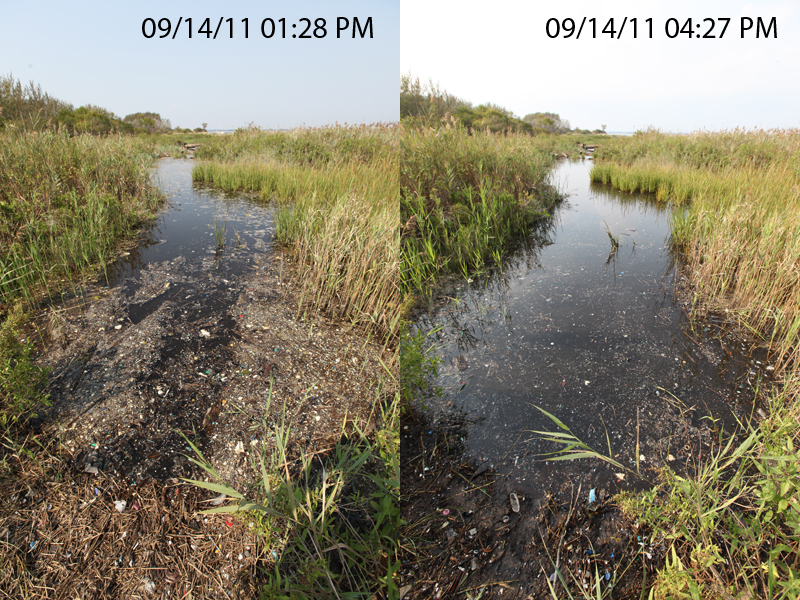
Look closely at these two marshes. (click to enlarge)


Yes, clever reader, they are one and the same.

This is thanks to the hundreds of volunteers who donated a Saturday to haul a few boards and rake a few piles. In three weeks we're going to make our last big charge of the season. The goal is to move the piles of wood and debris surrounding the marsh into dumpsters. If you're reading this and want to lend a hand, follow these directions and meet us at Rockaway Pier anytime between 10AM and 2PM on Saturday, September 17th. Bring work clothes, water and lunch, and we'll provide the gloves, tools and everything else. Leave a comment if you have any questions about getting there.

Some of you asked about the hurricane's effect on the marsh. I haven't been out there yet, but Tony made quick survey today and noted that the bayside dune appears shorter, and a few half-ton logs appear to have been liberated from the main pool. Did the hurricane flush out the marsh for us?  I'll post a full report Thursday, hopefully with camera trap hurricane action, so check back then.

Thursday, August 18, 2011

Day 37: Pole adjustments

No ospreys visited the platform this past week, although I saw one circling overhead today. The best camtrap capture was this juvenile night heron, who dropped by for a quick survey.


I think I set a record for how many starlings you can fit on an osprey platform. Eighteen by my count, not including the fifty just out of frame, squabbling over who gets to defecate on the camera next.


I mount and retrieve the camera trap using a 28' pole made from two pieces of PVC pipe with a hook jammed into the end. Someday I'll post a video of the process, which has been described to me as both mesmerizing and pathetic. The pole saves me from hauling an extension ladder back and forth from the marsh, but I pay for it with wracked nerves and burning forearms. It's always a wobbly affair that can take up to five minutes. As the camera whips around, it sometimes captures Dali-esque visions of the marsh.


To speed the mounting process, the pole would need some high-tech mods. So I replaced the zip tie spacers with bolts and wing nuts to keep the hook from swiveling. Then I clipped the "safety barb" off the end of the hook, to keep it from snagging the wire. And finally, I replaced my old wire with a shorter loop of heavier gauge. The upgrade works like a charm. 


It used to be easy to get dramatic before-and-after cleanup shots. But now, most of the heavy debris lies beneath the surface.


A few plasticy corridors remain, however.


I called it an early cleanup day and headed back to the shop where acres of reclaimed marsh plywood await the table saw. I still aim to recycle as much of the wood as I can. Next project: bat boxes. 


They'll be the wall or post-mounted type, like this. And they'll be free to anyone who's willing to pick them up, so leave a note if you want one.

High of 80, max humidity 87%, average wind (na) @ 8 MPH, 5.2 high tide @ 11:41 AM. Moon 84% visible.
Water level recorded at 10 inch mark.
Birds seen in marsh: common tern, unidentified peep, mockingbird, green heron, white egret, osprey, forster's tern
Birds seen in bay: common tern, laughing gull

Thursday, August 11, 2011

Day 36: Marsh casserole, with a side of bad juju

Bad juju would have been understandable on day 13, but day 36? I'm only marginally superstitious. But I tend to believe that rotten luck comes in threes. And today, it did indeed.

#1
Last week, Russ graciously offered me the use of his jumbo double-wheeled wheelbarrow. Being alone today, I was going to get a lot done with that bad boy. But the tires needed air. A few seconds after I plugged in, something started crackling inside. Before I could hit the release valve, an ominous bubble blistered up and without further ado went off like a howitzer. Russ, I owe you a tire.


#2
I usually wear Tony's size 12 rubber boots, a bit big for me. Today I saw a pair of size 11's flopped over in the corner. They were ancient, covered in dust, and had a strange aroma, but they fit like Cinderella's pumps. Into the marsh I went. Two seconds later that unmistakable sensation of moistness where there should be dryness took hold. I leapt out of the water but it was too late, the tops of my socks were soaked. Upon closer inspection, I found the boots lacerated with more creases than Charles Bronson. 


#3
No problem, I thought. The cam trap will cheer me up. I'd been looking forward to checking it all week. The shorebirds are migrating, the raptors are chasing them, whatever. I really thought I'd catch something special. What did I get? One hundred pictures of starlings. 


They weren't even doing anything interesting, just loitering, by the dozen, playing havoc with the motion sensor. Here's the tally: starling (too many to count), osprey 1, female red-winged blackbird 1, mockingbird 1, great blue heron 1 (on marsh). My worst haul yet.

Anyway, the three pieces of juju were over, and they weren't debilitating. While cleaning up, I noticed  evidence of luck -both good and bad - scattered throughout the marsh. Like a melting jellyfish. The lives of jellyfish are about as dictated by luck as anything you'll find in nature. They drift helplessly through the ocean, their course plotted by the currents, their fate determined by the tides. Last night, a sandy death was simply in the cards for this individual.


An empty egg case. The little skate that emerged from it was no larger than a nickel. With any luck, it will one day stretch five feet across.


Even trash can be traced to past luck.


And then there's this marsh, the luckiest marsh in New York City.


High of 82, max humidity 73%, average wind W @ 4 MPH, .3 low tide @ 12:42 PM. Moon 91% visible.
Water level recorded at 8 inch mark.
Birds seen in marsh: common tern, unidentified peep, yellowlegs, goldfinch, mockingbird, green heron
Birds seen in bay: semipalmated plover, oystercatcher, common tern, laughing gull